
Overview
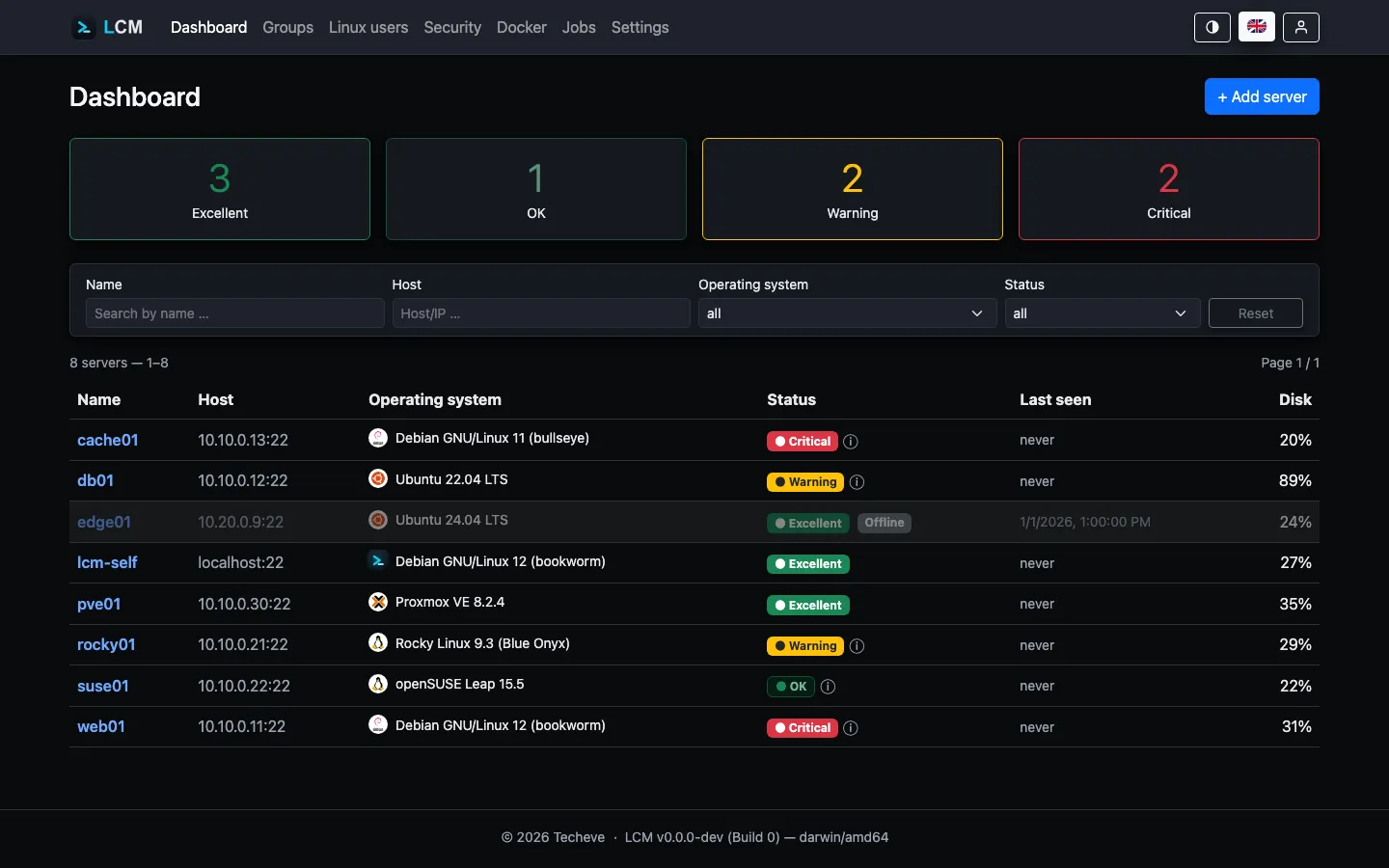
LCM (Linux Centralized Management) manages any number of Linux servers centrally over SSH - with no agent on the target systems. Backend (Go) and frontend (Svelte 5) ship as a single binary that keeps its data in a local SQLite file.
Why LCM?
Section titled “Why LCM?”- Agentless. Nothing needs to be installed on the managed servers. LCM connects over SSH, reads the state and runs actions as a dedicated service user.
- Zero trust per server. Every server gets its own SSH key pair during onboarding. A compromised key never endangers the whole fleet.
- One binary, no runtime dependencies. Copy, start, done - on Debian and Ubuntu (other Linux distributions work but are not part of our testing).
- Security built in. Sensitive data is stored AES-256-GCM-encrypted in the database; access is protected by RBAC and optional 2FA.
Core features at a glance
Section titled “Core features at a glance”| Area | What LCM does |
|---|---|
| Onboarding | Guided join with host-key confirmation (MitM protection), service user + own key pair per server |
| Monitoring | Packages, updates, repositories, hardware; Excellent / OK / 🟡 / 🔴 status with insights (incl. EOL & reachability) |
| Disks | All mounted volumes with usage; hourly history + forecast of the root filesystem |
| CVE scan | Daily Trivy scan of the package inventory (SBOM-based, no extra server contact), context-aware weighting |
| Docker | Inventory of containers/images, central registry update check, image CVE scan |
| APT cache | Attach to apt-cacher-ng via one-click action or group rule |
| Firewall | Multi-backend (ufw/firewalld/nftables) per distribution, detailed rules with source restriction (allowlists + custom IPs) |
| Security tools | Install fail2ban or CrowdSec at the push of a button; central CrowdSec LAPI on the LCM host |
| IP allowlists | Named, reusable source-IP lists for firewall, fail2ban and CrowdSec |
| Automation | Server groups with scheduled and baseline rules, internal scheduler; actions like reboot, restrict privileges |
| Users | Manage Linux users centrally and distribute their SSH keys |
| Backups | Encrypted, portable .lcmbak archives with restore on startup |
| Alerts | Rule-based notifications (disk, CVEs, reboot, heartbeat …) via e-mail |
| LCM Remote | Servers connect outbound via an agent (NAT/roaming) - dedicated port, agent interface only |
| RouterOS | Onboard MikroTik devices and monitor their OS version currency |
| MCP | Read-only interface for AI agents (dedicated port, authentication, no secrets) |
Architecture in one sentence
Section titled “Architecture in one sentence”An HTTP server (Fiber) serves the embedded Svelte frontend and exposes a REST API; an internal cron scheduler triggers jobs that an executor runs on the target servers over short-lived SSH connections and records as jobs including console output.
More detail: Architecture.
Where to next?
Section titled “Where to next?”- Installation - binary,
.debor Docker. - Quickstart - onboard your first server.
- Servers & Monitoring - the day-to-day workflow.